
India's fortunes will start reviving by 2018 when it will be at the ninth position, followed by fourth in 2023, before grabbing the third spot in 2028.

The Brics line-up has yielded to a shaky China-India story, with new question marks over China even as India remains a "B+" performer, says T N Ninan.

Rejecting IMF and World Bank's "unduly" pessimistic projections, Prime Minister's key economic advisory council chairman C Rangarajan on Thursday exuded confidence that the growth would be around 5.5 per cent in the current fiscal.

Reliance was the top gainer in the Sensex pack, surging over 3 per cent, followed by ICICI Bank, Bharti Airtel, Dr Reddy, Maruti and ITC.

Whereas the headline growth rate appears very respectable, India needs faster to growth to generate jobs.

Economics and politics both have major roles in determining oil prices.
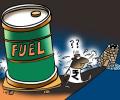
A rise in petrol and diesel consumption can help the government cut cesses on the fuels by Rs 4.5 a litre without impacting revenue collections of FY21, and help cool off the pressure on inflation, domestic rating agency ICRA said on Friday. Petrol consumption is estimated to increase 14 per cent in 2021-22 and diesel by 10 per cent on the lower base, rise in mobility and economic recovery, ICRA said. The rating agency added that it will result in an additional Rs 40,000 crore in revenue for the government through higher collections of the cess.

Tata Motor's owned Jaguar Land Rover (JLR) on Tuesday reported a 68 per cent increase in retail sales for the first quarter ended June 30 at 124,537 units as compared with the same period of the previous fiscal, reflecting the continuing recovery in demand from the COVID 19 pandemic. The company had retailed 74,067 units in the April-June quarter of 2020-21. However, wholesales, in particular, were lower than demand would have permitted due to semiconductor supply issues affecting the global auto industry, JLR noted in a statement.

India would be a major beneficiary of softer oil prices among the G20 economies as the country is a major crude importer.
While the Reserve Bank and the Economic Survey of the finance ministry have projected India to grow at 6.9 per cent and 6.5 per cent in current fiscal, the International Monetary Fund estimates it to be 6.6 per cent.

China and India evoked the highest levels of confidence among major economies at 45 per cent and 40 per cent, respectively. The US was at 36 per cent, Canada at 27 per cent, the UK at 26 per cent, Germany at 20 per cent, France 18 per cent, and Japan having the least optimistic CEOs with only 11 per cent very confident of growing revenues in 2020.

The ugly underbelly of the policies of economic liberalisation followed over the last two decades has been crony capitalism at its worst.

China with 163% projected growth is expected to lead globally.

The World Bank on Sunday said the coronavirus outbreak has severely disrupted the Indian economy, magnifying the pre-existing risks to its outlook. In its 'South Asia Economic Update: Impact of Covid-19', the World Bank estimated the Indian economy to decelerate to 5 per cent in 2020 and projected a sharp growth deceleration in fiscal 2021 to 2.8 per cent in a baseline scenario.
.jpg)
The RBI said lead indicators point to continuing sluggishness in domestic economic activity in the first quarter of 2014-15.
Unctad's GDP projection is broadly in line with forecasts by Indian agencies like the Reserve Bank of India and the Prime Minister's Economic Advisory Council, which have projected a growth rate of 7.9 per cent and 7.7 per cent respectively in 2008-09, as against 9 per cent recorded in 2007-08. Finance Minister P Chidambaram expects the Indian economy to expand by more than 8 per cent this year.

Expressing disappointment over the RBI's move for not cutting the key policy rates, India Inc on Tuesday asked the government to take immediate action to revive growth and boost investments.

In the manufacturing sector, output is expected to decline by about 70 per cent as only food-processing, and drugs and pharma industries are allowed to operate while other segments, such as engineering and metals, have shut operations.

India's economic growth is expected to improve to 6.3 per cent in 2016 with the country leading economic recovery in South Asia, according to a United Nations report.

The repo rate has been left unchanged at 4 per cent, Governor Shaktikanta Das said while announcing the decisions taken by the central bank's MPC.
Prof B B Bhattacharya says his forecasts are more 'judgemental' today, along the lines of the forecasts of other institutions including the RBI. Excerpts from a conversation with Sunil Jain.

The Index of Industrial Production (IIP) grew by 1.4 per cent in November as most components like manufacturing, electricity, mining, primary goods, and consumer durables witnessed a slowdown, according to data released by the National Statistical Office (NSO) on Wednesday. This is on the base of a decline of 1.7 per cent in November 2020 and before the new Covid variant started impacting economic activity. IIP growth was lower than the 4 per cent expansion recorded in the previous month but was better than a 1.6 per cent contraction seen in November 2020. Separately, rising prices of kitchen staples pushed retail inflation, or rate of price increase, to 5.59 per cent in December 2021, bringing it close to the upper band of Reserve Bank's comfort zone.

After swinging nearly 330 points, BSE Sensex finished 172.69 points or 0.43 per cent higher at 40,412.57. Similarly, the 50-scrip NSE Nifty appreciated 53.35 points or 0.45 per cent to close at 11,910.15.
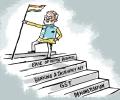
The report says, the emerging markets continue to have uneven performance but India recovers from decelerating growth. Narendra Modi government, it added, continues business-friendly growth reforms, the economy grows at 6 per cent and the market rises 20 per cent.

Besides Surat, which will also be the world's fastest growing city during 2019-35, the other nine cities are Agra, Bengaluru Hyderabad, Nagpur, Tiruppur, Rajkot, Tiruchirappalli, Chennai and Vijayawada.
The 50-issue NSE Nifty in range-bound movements settled higher by 59.15 points, or 0.58 per cent, at 10,252.10.

Cars and two-wheelers attract 28% GST and a cess in the range of 3-22%, taking the effective tax rate to up to 50%.

Forecasts of a further rise in bullion prices keep Indians away from selling gold.

Adverse economic conditions in Europe, demand-supply imbalance led to impairment.

'The recovery process for the Indian economy would be gradual'.
Amid fears of a third wave of coronavirus pandemic and hardening of retail inflation, the Reserve Bank is likely to maintain status quo on interest rate and watch the developing macroeconomic situation for some more time before taking any decisive action on monetary policy. The RBI is scheduled to announce its bi-monthly monetary policy review on August 6 at the end of the three-day meeting -- August 4-6 -- of the Monetary Policy Committee (MPC). The RBI Governor-headed six-member MPC decides on the key policy rates.

Indian banks are the 2nd-fastest-growing ones.

Other gainers included SBI, Kotak Bank, Sun Pharma, Tata Motors, M&M and Tata Steel, rising up to 5.19 per cent.

The G20 meeting of the finance ministers and central bank governors beginning July 19 will also be attended by Reserve Bank of India Governor D Subbarao and Deputy Governor Urjit Patel.

The S&P BSE Sensex plunged 461 points to end at 25,603.
Top gainers in the Sensex pack included ICICI Bank, Infosys, Bajaj Finance and HDFC Bank, rising up to 2.67 per cent.

E-way bill generation, which is related to paying Goods and Services Tax (GST) and a key high-frequency indicator of economic activity, may have fallen to a five-month low in April as more cities experience lockdowns due to a surge in Covid-19 cases. In April e-way bill generation may decline to 55-58 million, which is the lowest since at least November. On the higher side, it is a 17 per cent decline over March.

Irrespective of the global movement, gold prices in India are nearing the level of Rs 34,000 per 10 grams in the physical markets.
In January, the UN had forecast that the world economy would shrink 0.5 per cent this year. The report predicted that with a coordinated, development-oriented policy scenario, the world economy would recover to an annual growth of 4-5 per cent in 2010-2015, led by a robust growth of 7 per cent a year in developing nations.

The brokerage said that the reform measures announced by the government will help growth only over the medium term and are not expected to have any benefit in the near-term.
